
Dan’s Eulogy
PAUL
Paul Thresher, Betsey’s Nephew, raised by Betsey since age 14. Paul’s piece was read by Dan by request.
I never admitted this out loud, but she was a second Mother to me. The pain may not make me cry as much as it did before, but it’s there and just as familiar. I may not welcome this familiar pain, but the strength it grants me can be powerful.
DAN
Dan Scharlack, Betsey’s Son
As most of you know, Betsey was my mother. With my father Ron, she raised both me and my brother Jeremy, and found great joy and meaning in motherhood. But I think that for her, being a mother was bigger than just taking care of us. It was a movement that extended beyond our little family out into the world at large. She oriented around motherhood in a way that bordered on the archetypal, nurturing and caring for people without judgment or exception.
I have a sense that the committed woman who raised me was a mother long before she ever gave birth. She cared for her three younger siblings while growing up, attended to the most challenging students with compassion, let friends and family stay in her home whenever they were in need (many of you are here today), and unflinchingly took in and raised my cousins Martin and Paul after their parents died.
When I started to write the eulogy for my Mother, images of Duccio’s Maestà, with the Madonna enthroned, flashed in my mind. As an art historian, my mother loved this piece, and wept when we saw it together in person. In the composition Mary is as if not more centrally featured than Jesus. With a child in her lap, a warm look in her eyes, and the glow of the gold leaf that surrounds her body, there is a feeling that she is bringing a kind of spiritual love down into the world, and offering it to the crowd of people gathered around.
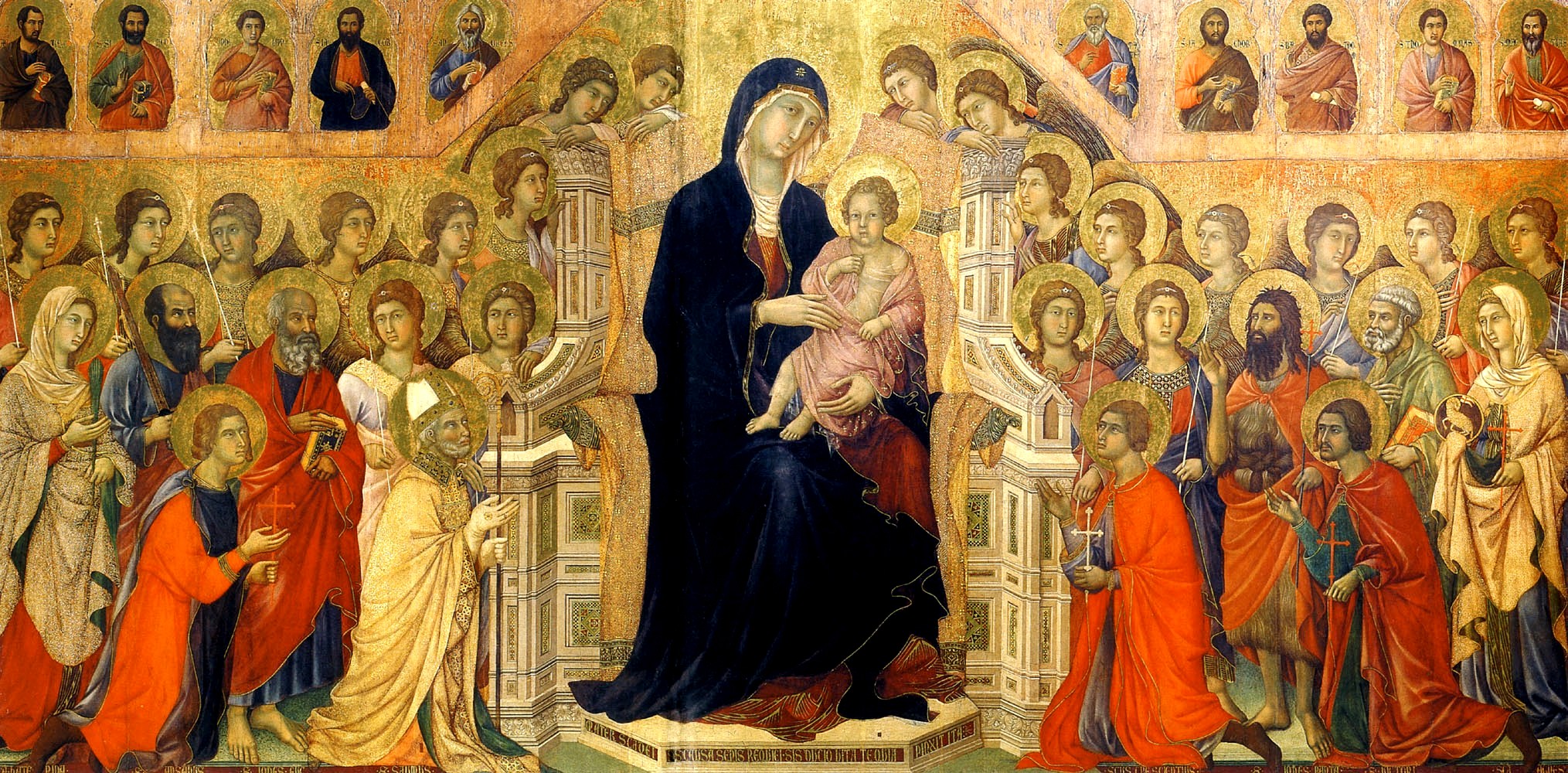
In a simple way this is what my mother was always endeavoring to do: bringing unconditional care and support those in need.
While I wrote this yesterday at the library I mused over the Duccio image for hours. I thought about this archetype, my mother, and whether or not to talk about the painting. When I returned to my parents apartment last night I saw mysterious box outside the door addressed to my Mother. My family and I opened it together. It was a gift from her dear friends at Museum of Fine Arts, another group of people that she had undoubtedly touched. They had ordered it a couple of weeks ago when she first got sick. Inside the box we discovered a beautiful reproduction of the very same Duccio painting.
My mother always touched and cared for the world, but it was often challenging for her to let herself take in the same care. She was a very private person, even by the accounts of those who knew her best, and was more comfortable offering support than receiving it. For reasons too complex to go into, it was at times hard for her to be vulnerable and trust that others would truly be there when she needed them.
The aggressiveness of my mother’s cancer suddenly and dramatically forced her into a position of needing to be taken care of, and us into a position of taking care of her.
As the days went on, she deteriorated quickly, and it became clear that she had less and less hope for survival. It was more of a question of when rather than if she would die. As this happened, those of us taking care of her became more simple in our love. We rubbed her back, we sang to her, massaged her feet, and fed her by hand. In other words, we mothered her. For me this was the grace inside of terrible illness, the gift of transformation at the heart of the tragedy: after taking care of us for so long, she finally began to let us take care of her.
In the final hours of my mother’s life all who had provided her care in the hospital were all gathered together: my brother, my father, her close friend Sharon Livesey, her dear cousin June Gardener, and me. We knew she was dying, and we sat around the bed together, crying softly, our hands placed lovingly on her body. I held my hand over her heart, and could feel her coming in and out of life, her body struggling to hold on, to take care of things and people just a little longer. She was slipping away, but couldn’t let go. It was hard for her to trust. She had to leave but was fighting to stay.
We all spoke to her encouragingly about relaxing. I sang to her, gently rocking her heart under my hand. She suffered but still she held on.
Eventually my father rose up, put his hands on her shoulders, and put his cheek next to hers. In a soft but deeply resonant voice he said
“You’re a fighter. You’ve fought for us a long time. But you can let go now. It’s ok to let go. If you let go we will catch you”.
As his words echoed through the room, I felt my mother truly let herself be held. Like a crying child met by the arms of a loving parent, her whole body relaxed into our touch. I felt her heart stop under my hand, and her spirit leave her body. A tremendous sense of peace flooded into the room. She was gone. We held each other and cried.
My mother lived a beautiful life of service. I am sure that influenced me in my decision to do social work, and later to become a therapist and spiritual teacher. She nurtured me and so many others in her lifetime. She offered unconditional love and support, as best she could, in every single moment.
In the end, with all that she did, the greatest gift I ever received from my mother was not that she took care of me, but that she taught me to take care of the world.